
49.35 IEEE® 802.15.4 RF Characteristics
| AC Characteristics | Standard Operating Conditions: VDD33 = VDDIO = AVDD
= 1.9–3.6V (Unless Otherwise Stated) Operating Temperature: -40°C ≤ TA ≤ +125°C for Extended Temperature | ||||||
|---|---|---|---|---|---|---|---|
| Parameter Number | Symbol | Characteristics | Min. | Typ. | Max. | Units | Conditions |
| ZBG1 | FREQ | Frequency Range | 2405 | — | 2480 | MHz | — |
| ZBG2 | FCH | Channel Spacing | — | 5 | — | MHz | — |
| ZBG3 | PSDU | Bit rate | — | 250 | 2000 | kbps | — |
| ZBT1 | TXOPPA | Transmit Output Power PA | — | 11 | — | dBm | — |
| ZBT2 | POWERRANGE | Output Power Range | -12 | — | 11 | dBm | — |
| ZBT3 | EVM | Error Vector Magnitude | — | 4.5 | — | %RMS | — |
| ZBT4 | MPA2HAR | Second Harmonic from MPA | — | -47 | — | dBm | — |
| ZBT5 | MPA3HAR | Third Harmonic from MPA | — | -45 | — | dBm | — |
| ZBRX1 | SENS | Receiver Sensitivity in 250 kbs | — | -103.5 | — | dBm | — |
| Receiver Sensitivity in 500 kbps | — | -100 | — | dBm | — | ||
| Receiver Sensitivity in 1 Mbps | — | -97 | — | dBm | — | ||
| Receiver Sensitivity in 2 Mbps | — | -91 | — | dBm | — | ||
| ZBRX2 | PMAX | Maximum Input Level | — | 0 | — | dBm | — |
| ZBRX3 | PACRP | Adjacent Channel Rejection +5 MHz | — | 20 | — | dB | — |
| ZBRX4 | PACRN | Adjacent Channel Rejection -5 MHz | — | 18 | — | dB | — |
| ZBRX5 | PALRP | Alternate Channel Rejection +10 MHz | — | 15 | — | dB | — |
| ZBRX6 | PALRN | Alternate Channel Rejection -10 MHz | — | 13 | — | dB | — |
| ZBRX7 | RSSIRANGE | Dynamic Range of RSSI | 75 | 80 | — | dB | — |
| ZBRX8 | RSSIRES | Resolution of RSSI | — | 1 | — | dB | — |
| ZBRX9 | RSSIBASEVAL | Minimum value of RSSI | — | -100 | — | dBm | — |
| AC Characteristics | Standard Operating Conditions: VDD33 = VDDIO = AVDD
= 1.9–3.6V (Unless Otherwise Stated) Operating Temperature: -40°C ≤ TA ≤ +125°C for Extended Temperature | ||||||||
|---|---|---|---|---|---|---|---|---|---|
| Parameter Number | Symbol | Characteristics |
RF Power |
CPU Frequency | Min. | Typ. | Max. | Units | Conditions |
| IZBTX_1 | IDDTX | TX Current Consumption in MLDO mode at 250 kbps | +11 dBm | 128 MHz | — | 52.7 | — | mA | VDD = 3.3V; Temperature = 25°C CPU Consumption included |
| +11 dBm | 64 MHz | — | 45.7 | — | mA | ||||
| +11 dBm | 32 MHz | — | 42.1 | — | mA | ||||
| 10 dBm | 128 MHz | — | 47.5 | — | mA | ||||
| 10 dBm | 64 MHz | — | 40.4 | — | mA | ||||
| 10 dBm | 32 MHz | — | 36.9 | — | mA | ||||
| 1 dBm | 128 MHz | — | 29.2 | — | mA | ||||
| 1 dBm | 64 MHz | — | 22.1 | — | mA | ||||
| 1 dBm | 32 MHz | — | 18.5 | — | mA | ||||
| IZBTX_3 | IDDTX | TX Current Consumption in BUCK mode at 250 kbps | +11 dBm | 128 MHz | — | 26.3 | — | mA | |
| +11 dBm | 64 MHz | — | 22.8 | — | mA | ||||
| +11 dBm | 32 MHz | — | 21.1 | — | mA | ||||
| 10 dBm | 128 MHz | — | 23.8 | — | mA | ||||
| 10 dBm | 64 MHz | — | 20.4 | — | mA | ||||
| 10 dBm | 32 MHz | — | 18.7 | — | mA | ||||
| 1 dBm | 128 MHz | — | 15.4 | — | mA | ||||
| 1 dBm | 64 MHz | — | 12.0 | — | mA | ||||
| 1 dBm | 32 MHz | — | 10.3 | — | mA | ||||
| IZBRX_1 | IDDRXZB | Current consumption in MLDO mode at 250 kbps | -95 dBm | 128 MHz | — | 23.6 | — | mA | |
| -95 dBm | 64 MHz | — | 16.6 | — | mA | ||||
| -95 dBm | 32 MHz | — | 13.4 | — | mA | ||||
| IDDRXZBRPC | — | 128 MHz | — | 21.5 | — | mA | |||
| — | 64 MHz | — | 14.7 | — | mA | ||||
| — | 32 MHz | — | 11.3 | — | mA | ||||
| IZBRX_3 | IDDRXZB | Current consumption in BUCK mode at 50 kbps | -95 dBm | 128 MHz | — | 12.9 | — | mA | |
| -95 dBm | 64 MHz | — | 9.7 | — | mA | ||||
| -95 dBm | 32 MHz | — | 8.0 | — | mA | ||||
| IDDRXZBRPC | — | 128 MHz | — | 11.9 | — | mA | |||
| — | 64 MHz | — | 8.7 | — | mA | ||||
| — | 32 MHz | — | 7.1 | — | mA | ||||
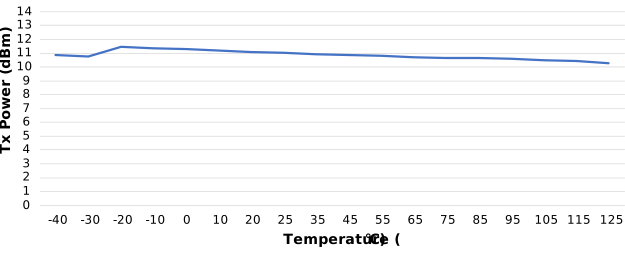
Note:
- Transmit power is measured after calibration.
- Transmit power is measured at 2440 MHz at 3.6V across temperature.
- Transmit power is measured after the PA matching and LPF.
- Transmit power compensation is triggered before measurement across temperature.
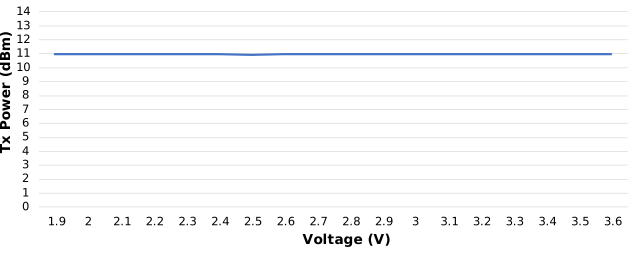
Note:
- Transmit power is measured after calibration.
- Transmit power is measured across voltage at 2440 MHz and 25℃.
- Transmit power is measured on reference board after the PA matching and LPF.
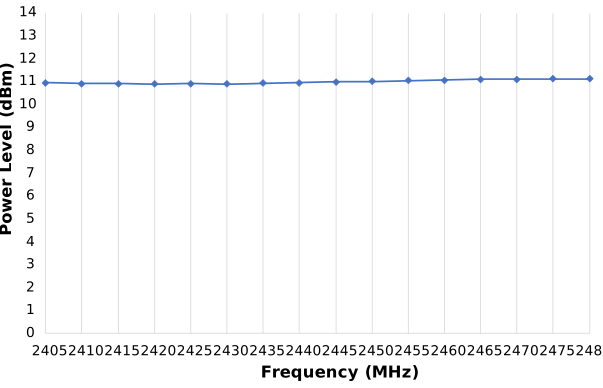
Note:
- Transmit power is measured after calibration.
- Transmit power is measured across the channels at 3.6V at 25℃.
- Transmit power is measured after the PA matching and LPF.
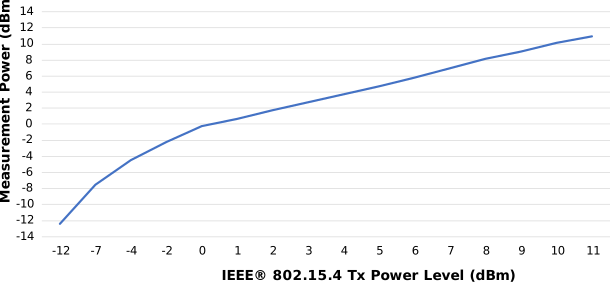
Note:
- Transmit power is measured after calibration.
- Transmit power is measured across power levels at 2440 MHz at 3.6V, 25℃.
- Transmit power is measured after the PA matching and LPF.
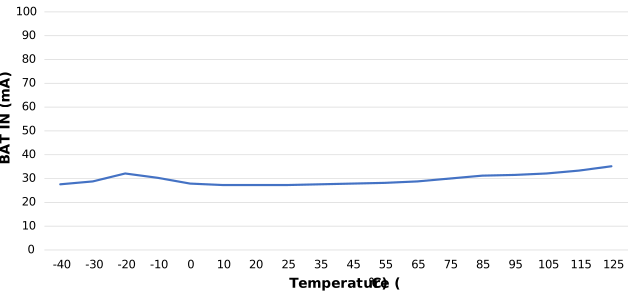
Note:
- Transmit current is measured at input to SoC (includes SoC power consumption).
- Transmit current is measured at 2440 MHz at 3.3V (Buck mode).
- Transmit power is calibrated to +11 dBm (± 0.5 dBm).
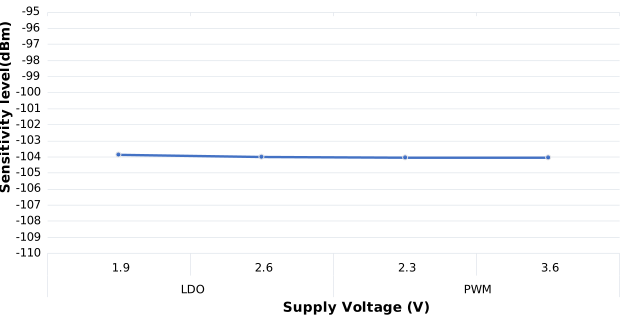
Note:
- Receiver sensitivity is measured at 2440 MHz at 25℃ across voltage, 250 kbps.
- Sensitivity is measured according to the 802.15.4 specifications.
- Sensitivity is measured after receiver calibration.
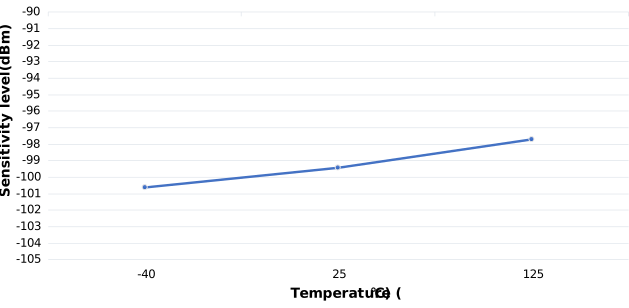
Note:
- Receiver sensitivity is measured based on the 802.15.4 specifications.
- Sensitivity is measured at 3.6V, 25℃ on 2440 MHz across temperature, 250 kbps.
- Measured after receiver calibration.
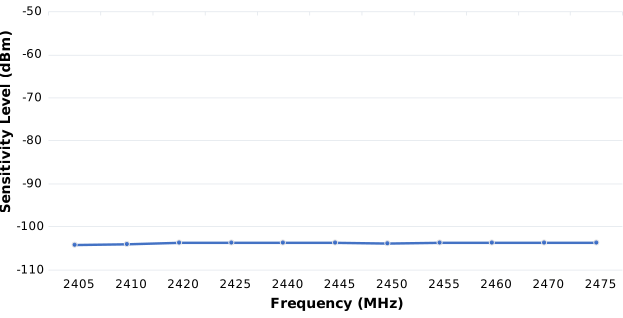
Note:
- Receiver sensitivity is measured across channels at 3.6V at 25℃, 250 kbps.
- Sensitivity is measured according to the 802.15.4 specifications.
- Sensitivity is measured after receiver calibration.
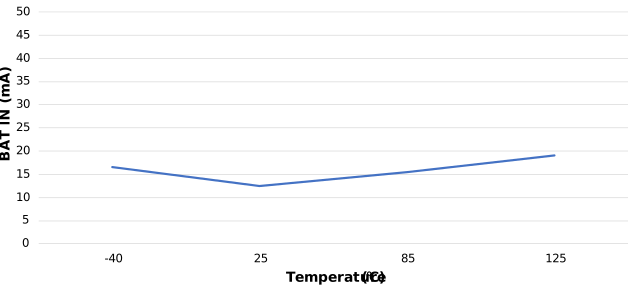
Note:
- Receiver operating at 2440 MHz, 3.3V (BUCK mode), 25℃ at maximum LNA gain.
- Sensitivity is measured after receiver calibration.
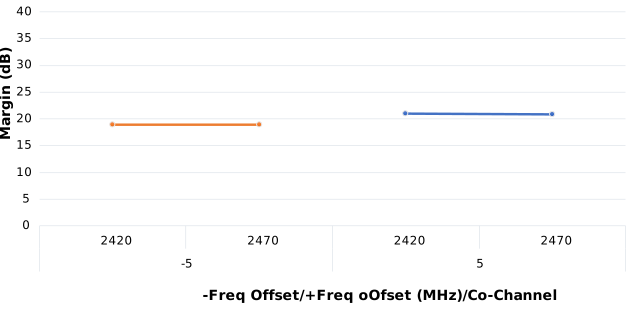
Note:
- Adjacent channel rejection is measured at 3.6V at 25℃, 250 kbps.
- Measured based on the 802.15.4 adjacent channel relative jamming specification.
- Margin specified is the margin above the 802.15.4 specifications.
- Measured after receiver calibration.
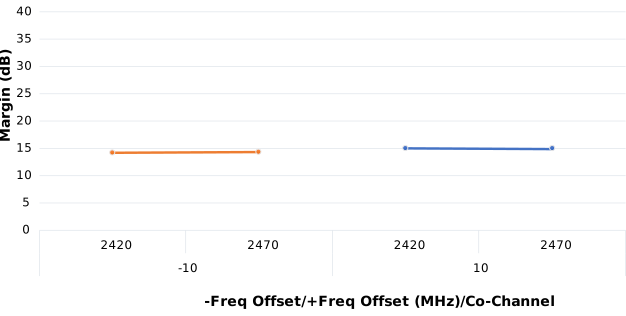
Note:
- Adjacent channel rejection is measured at 3.6V at 25℃, 250 kbps.
- Measured based on the 802.15.4 adjacent channel relative jamming specification.
- Margin specified is the margin above the 802.15.4 specifications.
- Measured after receiver calibration.
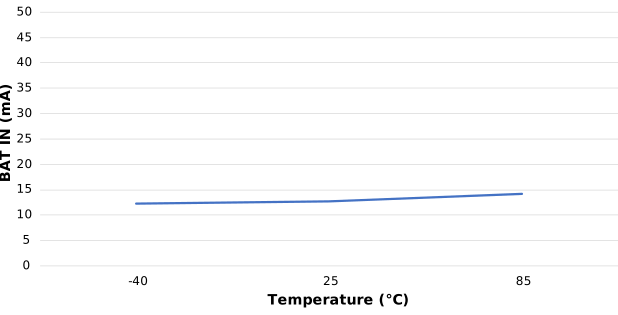
Note:
- Receiver operating at 2440 MHz, 3.3V, 25℃ at maximum LNA gain.
- Measured after receiver calibration.
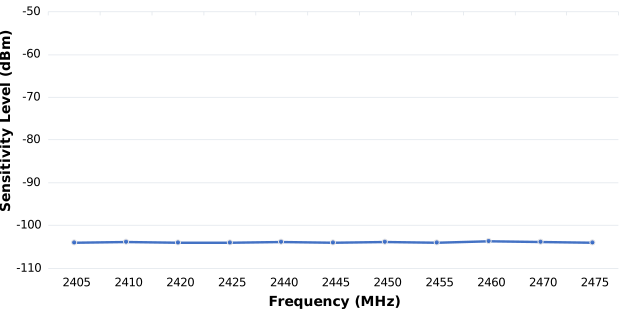
Note:
- RX sensitivity across channels is measured at 3.6V at 25℃, 250 kbps.
- Sensitivity is measured according to the 802.15.4 specifications.